Wednesday, September 27, 2006

hamsa earrings

My love affair with tiny metallic seed beads continues. Here's another pair of earrings made with size 15 silver and hematite coloured beads:


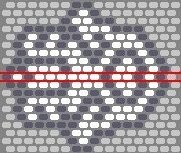
The design is a Hamsa, also called Hand of Fatima or Hand of Miriam, an ancient Middle Eastern symbol used by both Jews and Muslims. The hand with three fingers upraised is intended to avert the evil eye.

I've seen a number of variations on this design in various media, but none in beadwork, so I decided to design a beadwork pattern. And share it:

Saturday, September 23, 2006

The cat ate my beadwork

Well, chewed my beadwork, anyways. This was a pair of russian leaf earrings I created for fall, using size 15 silver beads. Unfortunately, I left them on the bedside table, and the cat knocked one down and started playing with it. The picture shows what he left.


I'll make another one up sometime soon. I'm also thinking I'd like a pair in bronze 15 seeds - a better colour for autumn.

Maria's Russian Leaf instructions. (Often her site is down, but it's also available from the Internet Archive)

Tuesday, September 05, 2006

The Other Eden by Sarah Bryant

What a beautiful little book, was my first thought on finishing this. But on second thought not so little; over 450 pages, but I read it in a couple of sittings and didn't notice time passing.

A cliche, but it's easier to criticize than praise, and I sometimes have trouble writing about the books I enjoy most. Especially ones like this, that I just absorb in a kind of uncomplicated gulp of reading pleasure.

It's a sort of literary gothic, full of family secrets. Most of the book is set early last century. with a prologue 20 years earlier, and a coda much later. Eleanor is a gifted young pianist, raised by her grandfather. On his death she moves to an abandoned family estate in the south with her companion Mary (rather uninteresting, as companions named Mary often are). The estate, the Eden of the title, is lushly beautiful in decay, tangled and haunted, perhaps poisoned.

Strange how I find myself thinking of the book with an almost southern gothic vocabulary. It's the language more than the plot I loved, I think, much as I do love these past-delving novels. Eleanor's mother and her mother's twin sister traded places so one of them could marry the man she loved - this is revealed in the prologue. Eleanor knows nothing of this, doesn't even know who her father is, or that her mother had a twin. In eden she learns, slowly, and with the help and hindrance of two mysterious men who are somehow tied to those events from before her birth. And even Mary plays a sinister role.

Sunday, September 03, 2006

The Algebraist by Iain M. Banks

This is one of the books I read during my two-week holiday/belated honeymoon in Prague and Budapest, mostly while in transit. (I'm a compulsive reader, but even I found more interesting things than reading to do in Europe.) I'll be catching up on my blog posting over the next few days. (A few days later: or weeks...)

This is also, incidentally, the book I was reading in Prague airport which I was forced to surrender to my checked luggage due to the terrorist threats that week.

I've read all of Iain M. Banks' Culture space operas, as well as some of his non-M. literary works. I think I would have appreciated this book more if someone else had written it; it was well-written, fun, and for Iain M., fairly average. Which is still very good...

I nearly didn't read it at all. Mr. Banks has a skill for writing vivid, memorable, utterly repellant scenes - the live-human-eating cult in Consider Phlebas comes to mind - and this book included one right at the beginning. I have what is sometimes an unfortunately visceral imagination, and the fate of the bodiless head that was being used for a punching bag was a bit much for me. Fortunately, the rest of the book was relatively light on such things.

As a side note, the Archimandrate Luseferous, the leader of the invading force who punched the disembodied head, broke so many of the rules on the Evil Overlord List that I was forced to wonder if Banks used the list while designing his character. (For example, see rules #17, #24, #49, and also the bits about properly securing ones' noxious pets.)

I missed the Culture. I like the odd interplay of moral shallowness and depths that their hedonistic, AI-supported society lends itself to... but back to the book in hand.

Dwellers are members of an ancient, galaxy-spanning civilization of gas-giant inhabitants who live for millions or, if lucky, billions of years. (Despite or because of this, to the casual human observer they often appear to have the approximate maturity level and attention span of a typical pre-teen, or possibly a celebutante.) Fassin Taak is a human scholar in Dweller Studies, one of the few non-Dwellers who actually gets to talk to Dwellers face to face and has some measure of understanding of them. To do this in the gas-giant atmosphere he employs a small, carefully-crafted ship. For various war and plot-related reasons, Fassin is sent on a mission to try and find an important Dweller document.

For me the Dwellers were the best part of the book. At first they seem to have been thrown in for comic relief, frivolous and bumbling, but there's more to them, and I think it's actually a fairly subtle portrayal. What would a society of beings that live, grow and learn for millions of years look like?

These look rather like the Culture, in a way. Both are civilizations whose inhabitants lack some of the basic motivators we take for granted. No economic motivators; technology's advanced and pervasive enough to do anything that needs to be done, produce anything that needs to be produced, on request. With universal lack of economic want goes most urges towards social change, philanthropy and activism, other important motivators in this reality. Science and engineering are a set of solved problems, and the main remaining field of inquiry is history. So, most of the concerns we consider serious and adult simply aren't there to be concerned about. Not surprising the beings in question might seem frivolous and hedonistic, even juvenile. They've not much to worry about except how to kill time.

Some do more than that, though. And gradually, we get to see some of what they've been up to.

One of the things I like most about Banks' Culture books is the way that background lets him isolate the biggest questions. They've delt with everything that can be solved with money and technology and medicine. The Dweller parts of this book didn't explore those themes, and the Dwellers themselves were more alien than anything biology-based in the Culture universe. But perhaps not alien enough, given the huge amount of time and life and biology that separated them from the quite comprehensible humans? I'm not sure. The book seemed to have more possibility than it used, in the end.

Wednesday, August 30, 2006

Thud by Terry Pratchett

What's to say? It's a Terry Pratchett book, and I've loved pretty much all of his books.

Saturday, July 29, 2006

Almost metalwork

More twisted herringbone. These hoops are made out of 15° silver-coloured seed beads.

Wednesday, July 19, 2006

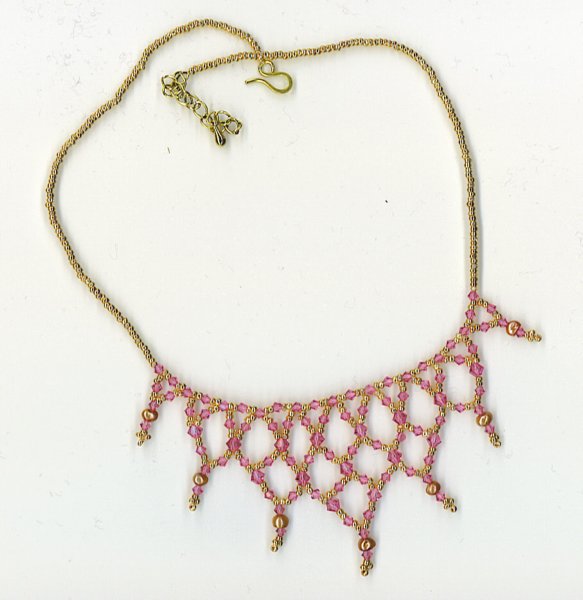
A net of crystal

A netted necklace with gold beads, pink crystals and pearls. The picture doesn't do it justice, it sparkles gorgeously in real life.

I created this as a wedding / graduation gift for a favourite student.

Based on Theresa's russian net pattern.

Tuesday, July 18, 2006

Labyrinths by Jorges Luis Borges

Missed this when I was entering my old posts. Well, there are no rules. No way to back-date, either.

Thunder and Roses by Mary Jo Putney, with digressions on the Romance genre

What's to say? She's my favourite romance writer. This book didn't stand out much among her others, but it was perfectly likeable.

The author was quoted on the back saying that "for pure romance, you can't beat Thunder and Roses." I actually found the romance a bit tepid. The heroine muses after realizing she's in love with (and having sex with) the hero "She would miss him when their odd relationship was over..."

I've had stronger reactions to impending separations from my cat.

Still, things to like. One thing I appreciated was that the heroine was the daughter of "respectable yeoman stock." Most of Putney's characters range from mid to high-level nobility - even the actress in One Perfect Rose turned out to be a mislaid heiress of some sort. I also enjoyed the Gypsy scenes - the hero was half Romany.

Mary Jo Putney was the author that showed me that I could actually like romance novels. I'd read them before I discovered her, of course, but mostly just because they were, well, there. I've always been something of a compulsive reader - if I'm not doing something else, and something written is available, I'll probably start reading it. (That doesn't mean I'll keep reading it, mind; I'm not that compulsive.) And my mother had a collection of romance paperbacks.

It would have been back in the early 90s that I came across these, and most of them were at least a few years old. So they would have been from the heyday of the bodice ripper, the days when "heroes raping heroines was part of the courting process," as a reviewer at All About Romance Novels put it.

So when I read Mary Jo Putney's Silk and Secrets, it was a revelation. I wrote this in my book log:

"I think what makes this book likeable while so many romances I've skimmed through seem fairly unpleasant is the fact that the hero was a genuinely nice guy. He was handsome and rich and brave and all that, of course, like most romance heros, but he wasn't overly "commanding", didn't bully his wife into doing what he wanted, never considered raping anyone, and while plausibly non-celibate, he wasn't famed thoughout the land for his sexual prowness or the number of marriages he'd broken up. He was just nice. I liked him."

Monday, July 17, 2006

More casualties of the car fire

The car fire I mentioned in an earlier post destroyed quite a few other things: my wedding dress and gifts, family photo albums, and more relevantly my supply of beads and several pieces of beadwork. (We were combining a trip to visit my relatives for Thanksgiving with a trip to collect some of the stuff we'd been storing at my father's place.) Not to mention the car... No people or animals were hurt, which is the important thing.

The Briana necklace was made following instructions in Cheryl Assemi's Beaded Elegance. The flowers were less red than they look in the picture, more of a cranberry.


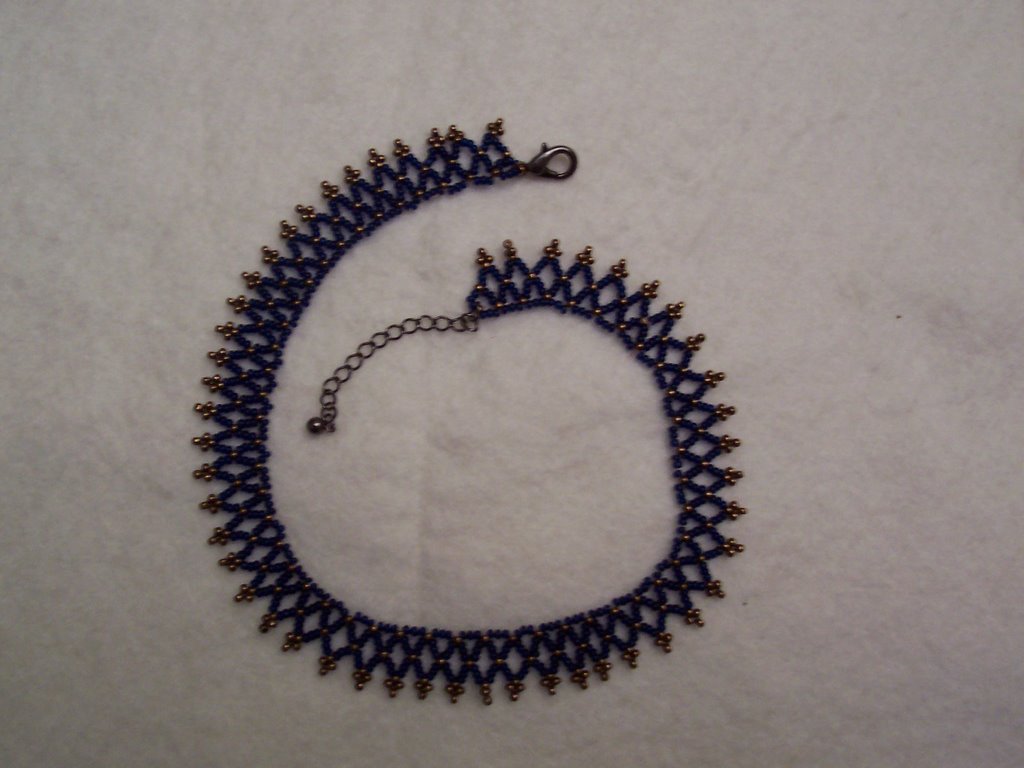
This is Eagle Spirit's Victorian Lace pattern, done in transparent navy and bronze czech seed beads.

Sunday, July 16, 2006

The Ghost Orchid by Carol Goodman

Another of Carol Goodman's literary mysteries, a review I found calls it, but this wasn't really a mystery at all, even though it contained questions that slowly were answered. More a novel of the supernatural, almost a more erudite version of one of Marion Zimmer Bradley's parapsychologicals.

Writers and artists are invited to Bosco, a retreat where they can create undisturbed all day. Ellis is writing a novel about a sequence of events involving a medium that took place at Bosco over a century before. And strange things happen...

The story of modern Bosco is interleaved with the story from the past, and I wasn't quite sure if what I was reading was Ellis's novel or the events she based it on. No matter, or perhaps, no difference.

Goodman's books are plagued by coincidence. The odd hidden relationships of the characters, the mediums' tools left under the bench for a century for Ellis's mother to find... it didn't bother me so much in this one, given the supernatural hand in things, but the spirits still needed help from a good dose of unlikely happenstance.

But the unlikely happenings all fit together and grew into something genuinely touching, and subtly creepy. And there's this line near the end:

"This disconcerts me more than the broken teacups and disembodied voices and Diana speaking in tongues--that Zalman's beautifully ordered poems have gotten scrambled together..."

All her earlier books have water in the title: Lake, Water, Drowning. This didn't, but the fountains of Bosco ran through it, and the book might almost have been called Muse of Water along with the biography of Bosco's founder one of the secondary characters was writing. But perhaps the bog orchid was wet enough.

And it fit very well with her earlier books, even if they are more like traditional mysteries. They're all also of another subtype I really enjoy even if I have trouble defining it. I'm not sure what else fits the mould. A. S. Byatt's Possession, yes, though not her others. Some of Robertson Davies, perhaps; Rebel Angels or maybe Lyre of Orpheus. Amanda Craig's In a Dark Wood, which is like Goodman's earlier Seduction of Water, but also another thing entirely. Maybe Fiona Mountain's Pale as the Dead - that's genre mystery, but I think it's good in non-genre ways too. These are books with a sense of place and time, a delving into some real or imagined past, a centrality of arts or literature - not just "literary mystery" as in mystery well-written, but a mystery of literature. Well-written is good too. If any reader knows what I'm trying to get at, I'd appreciate suggestions for other books in the same vein.

Amulet Purses

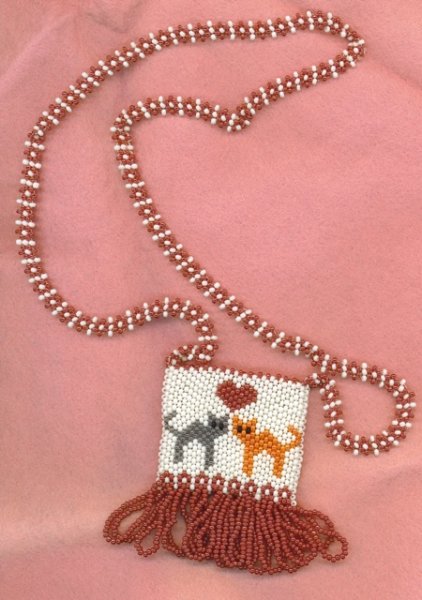
I'm mostly not a fan of amulet purses - I want a purse I can actually carry something in - but I've made a couple to give as gifts.

I created this for my friend Margaret, who has two cats. The orange one is a female named Willow, and the grey is a male called Trogdore. I used czech seed beads, and I like the crafty, folk art look that the beads' slight irregularity gave the design.


It's my own design, based on Emily Hackbeth's cat earrings. Here's the pattern:

The strap is a basic daisy chain.

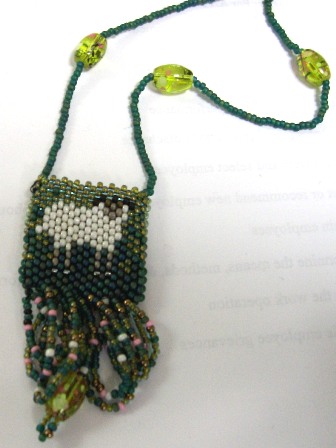
My only other amulet purse so far is this tiny sheep, created, naturally enough, for my former co-worker Sue who keeps sheep. The pattern is a slightly modified version of Aunt Molly's sheep. This one uses japanese seed beads, which are more regular than the czech ones.


I still want to make a purse I can carry things in. Entirely out of beadweaving, mind; not cheating by adding some beads to a cloth or leather purse. One of these days when I'm feeling ambitious, I guess.

Saturday, July 15, 2006

Memorial for a Russian Leaf set

This Russian Leaf set was the first large project I attempted and the first that I designed myself, and I was very fond of it. Unfortunately, it was destroyed in a car fire.

The rope is tubular peyote, and I made the leaves using Maria's instructions. (Often her site is down, but it's also available from the Internet Archive)

Sunday, July 09, 2006

Key of Light, Knowledge, Valor by Norah Roberts

Three for one!

I really enjoyed this series. Great light reading airplane-type books, and I did even read one on an airplane.

Combined romance with a nicely done fantasy quest. But mainly I really liked the portrayal of the friendship between the three women. As wish-fullfillment goes, the friendship was more satisfying than the romance. I'm not sure if that says more about me, or about the portrayals of the male characters. But then, romance is rather easier to find. Hapily-ever-after books about friendship I think are rarer.

Key of Valor, the last in the trilogy, didn't work for me as a romance at all. The only thing I can remember about the hero is that he was rich.

The Battle of Evernight by Cecelia Dart-Thornton

Third and last in a series; if you care about spoilers, please don't read further.

Hard to get through. I don't know why; the prose was rather impenetrable, but no more so than in her earlier two, which I found oddly readable despite that. The plot, partly - it wandered, but then the earlier two did as well. Characters? Fewer interesting secondary characers in a less interesting setting, or maybe I'd just lost patience with them somehow.

A pity, because I did enjoy the earlier two, and also because she did come up with good answers for some of the things I disliked in the earlier books - Thorn was inhumanly attractive and capable because he was, in fact, inhuman, for one.

I choose to believe the second option at the ending - that she was spirited away by her unworldly lover to beyond the gate. The other was too pointless and stupid a tragic ending, and unworthy of both the prince and his supposedly befuddled bride.

Unless by Carol Shields

A very deeply felt feminist book, in a way I haven't encountered lately. Not harsh, or angry; a sort of soft muted almost passive protest, yet one that came through very clearly, most of all in those unsent letters Reta wrote. All those passive abstract words, adverbs and prepositions: goodness, unless, thereof, despite... "whatever" didn't quite stike the right note, though.

The book kept me a little too distanced from Norah, who I instinctively wanted to be the center of it. But really it was about Reta, and I can accept that, her trauma of disconnect from her daughter.

Red Heart of Memories by Nina Kiriki Hoffman

A book I've been looking for so long it almost had to be a dissappointment. Except it wasn't; much better than the incoherent sequel.

Trauma and recovery, of course, and magic. Talking things. Only the trauma was a little shallow, the recovery too easy, Susan's father too symathetic at the end. Oh, but the landscaping was lovely, the house, the chittering airplane tickets.

But not the people.

No, that's not quite true. I found myself picking it up and starting over, and I'd forgotten how riviting I found the relationship between Matt and Edmund at the beginning. It was very real. But somehow it lost focus somewhere half way through.

Life Studies by Robert Lowell

Poetry collection. I was plugging at this off and on over a few weeks, reading it on coffee breaks at Starbucks, lunch hour in the cafeteria, buses. Not with my comfort reading at home in the bath. Finally finished it while waiting for a bus at the mall.

Interesting. Bits of masculine emotion and childhood I had difficulty relating to, bits of history I liked, faintly religious musings I was fascinated by, and at the very end some moments from a breakdown, and after, that helped me understand why Alvarez considered it such an important book.

The style... I'll have to read it again just to absorb the nuances... rhymes so subtle I missed them on first reading, rhythm faint, never jarring.

But much of it didn't grip me, quite.

The Secret History by Donna Tartt

Odd book. I tried to read it several times because the themes I was told were in it appealed to me, but kept getting bogged down near the beginning. I finally managed to get into it by skimming ahead to just past the point where I had difficulty, and read the rest compulsively.

I've never read a book with such a collection of completely self-absorbed, amoral characters. Charles reactioning to the first murder: "It wasn't like it was Voltaire we killed, but still, I feel bad." Henry, trying to push the blame on Coke, or Richard, or anyone, really. Bunny, the only one disturbed by the first murder, but casually stealing food, defacing books, his skill for finding others' weak points and pressing them - and his entire family so concerned with their image. The entire student body, even, with their affectation of grief.

The structure of the book seemed off. I expected the Dionysian murder to come at the climax. Instead it took place unnoticed by Richard near the beginning, followed by the casual killing of Bunny. And then the breakdown - I think it was the questioning by the police, and the apparent betrayals by Henry, that precipitated them. The breaking of the group, not remorse...

Sin by Josephine Hart

Intense, rather perverse book, with an intense and very perverse heroine. (Heroine? Villain?)

About a woman, Ruth, whose life, whose entire being is built around her hatred for her adopted sister, her cousin. She thinks of little else, cares for nothing else (except her son), chooses her lovers and husband as parts of schemes to hurt her sister. Finally manages to sleep with her sister's husband, and destroys all their lives. Well, that and the accidental death of her son, and her sister's...

Perhaps too intense a focus on the hatred? Nothing else to Ruth at all, to the other characters... hard to read, hard to believe.

Her husband - now that was a relationship I did believe. His adoration, her indifference, eventual giving in because it was convenient. Twisted.